Polymarket Priced Gkolomeev at 85¢ to Break the Record and 23.5¢ to Win the Race
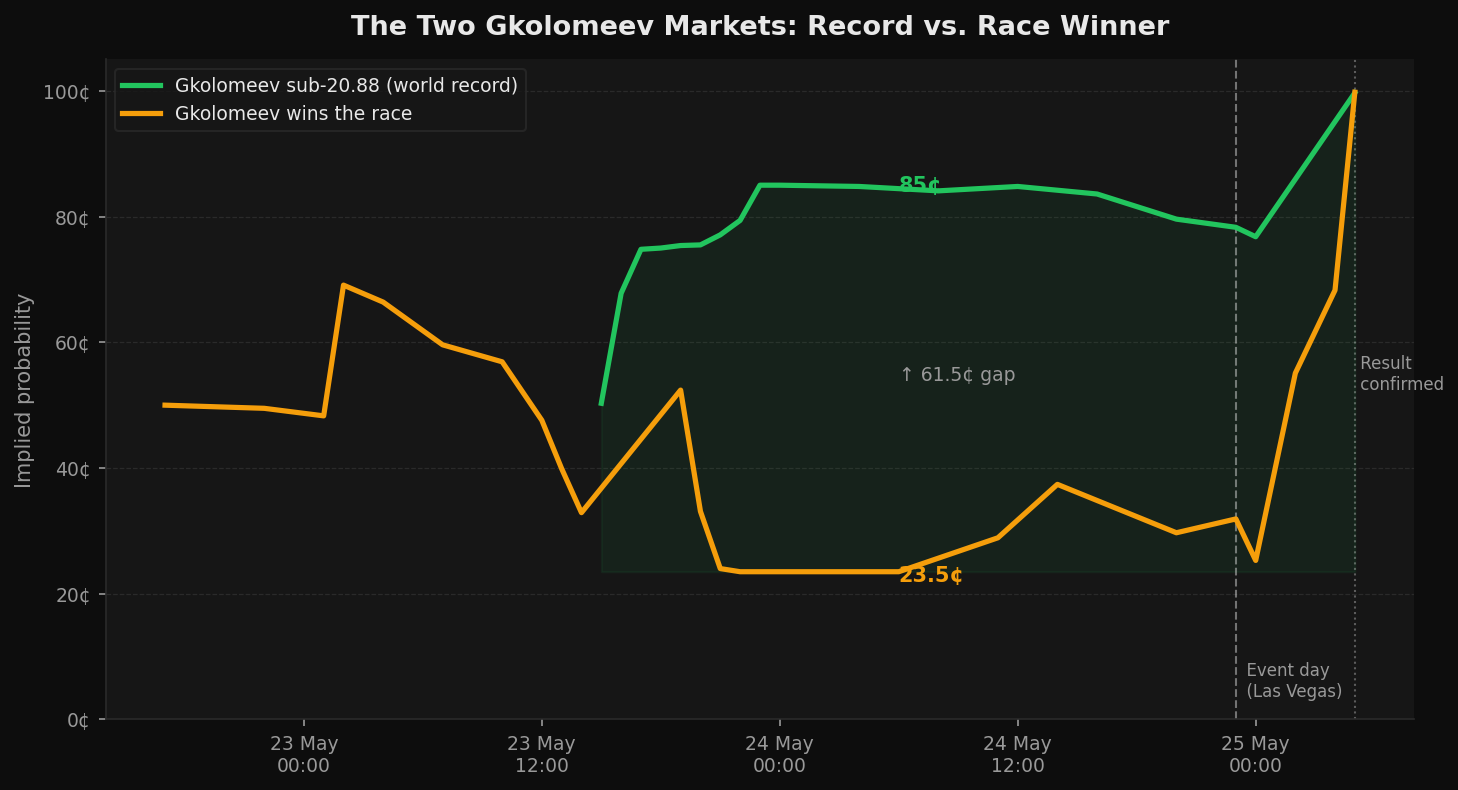
The Enhanced Games just concluded with one world record and one glaring prediction market anomaly: 85¢ to break the world record, 23.5¢ to win the race. We dug into all 122 markets.

Two prices, from the morning of May 24, 2026:
"Will Kristian Gkolomeev swim the 50m freestyle in under 20.88 seconds?" — 85¢
"Will Kristian Gkolomeev win the 50m freestyle?" — 23.5¢
One of those is almost certainly wrong. If you're 85% confident someone will break a world record in a race, the logical upper bound on a competitor winning that same race by going even faster is 15%. Yet Polymarket's crowd had Ben Proud, Gkolomeev's main rival, at 75.5¢ to win.
By midnight Las Vegas time, Gkolomeev had touched the wall in 20.81 seconds — seven hundredths under the old record — and pocketed the $1 million bonus. Both markets resolved at 99¢. Ben Proud finished second.
The prediction market ecosystem around the inaugural Enhanced Games — 122 separate markets across swimming, sprinting, weightlifting, and bonus payouts — produced some of the most interesting cross-market correlation failures we've seen. The crowd got the record right. It got the race completely wrong. And hidden inside the "how many world records" market, there's a neat explanation for exactly why.
The Enhanced Games as a prediction market stress test
The Enhanced Games are, among other things, a controlled experiment: take athletes who openly use performance-enhancing drugs banned by WADA, put them in competition, and see what happens to world records. That framing made it perfect for Polymarket. Instead of a diffuse "will the election go to X" market where signal is noisy and hard to attribute, you had specific, time-bounded, independently resolvable propositions: will this swimmer go under this time?
That specificity is what makes the calibration failures so interesting. These aren't politics markets where the underlying probability distribution is fundamentally unknowable. They're physics markets. How fast can a human swim 50 meters while using every legal pharmacological tool available? That's a question where domain experts — coaches, sports scientists, people who track training footage — should have a genuine edge over the crowd.
So what happened?
The world record markets: mostly right
Start with the easy ones.
The 100m sprint world record market (Bolt's 9.58) opened with Yes at 46¢ and drifted steadily downward as event day approached, settling at 8.8¢ by the morning of May 24. Fred Kerley, who had made noise about beating Bolt's mark, fell short. The market correctly assigned this a low probability and was rewarded. $10.7 million traded on that single market on event day alone — the highest volume of any Enhanced Games market — which suggests the crowd was paying attention.
The 50m freestyle world record market followed a different path. It opened on May 23 at exactly 50¢ and within one hour had jumped to 68¢. By the end of the day, it was holding at 85¢ — implying someone had traded it up hard in the first few hours after the market was created. It held that level through the morning of the event and resolved at 99¢ when Gkolomeev posted 20.81.
The 1+ world records market, which opened on event day itself, corroborates the story: it surged from 50¢ to 94¢ by late evening on May 24 as early results filtered in. The crowd was right that at least one world record would fall.
Where it broke down: the winner market
Here's the anomaly. While Gkolomeev's world record market was sitting at 85¢, his winner market — a completely separate Polymarket event — had collapsed to 23.5¢ and locked there.
Ben Proud, the British swimmer who held the non-enhanced world record in the 50m butterfly (22.27s, though he swam 22.32 in Las Vegas), was sitting at 75.5¢ to win the 50m freestyle. The market had essentially crowned him 24 hours before the race.
This combination — 85¢ Gkolomeev breaks the record, 75.5¢ Proud wins — is only coherent under one specific scenario: Ben Proud also goes sub-20.88 and beats Gkolomeev by going even faster. For the two prices to be internally consistent, you'd need to believe there's roughly a 61% chance Proud executes a sub-20.88 swim. (If Gkolomeev is 85% to break it, the only way Proud wins at 75.5% is if Proud can also get there with similar frequency.)
And this is exactly what the "2+ world records" market was saying.
The macro market that tied it together
The "2+ world records broken" market — meaning two or more swimmers would shatter existing marks — opened on event day at 50¢ and quickly ran up to 74.5¢. The crowd's implicit model was: multiple records fall, Proud is the faster of the two. That was the narrative.
It started unwinding around 20:00 UTC on May 24 (3pm Las Vegas time), when the 2+ world records market pulled back from 74.5¢ to 67.5¢, then to 51¢ by 21:00 UTC. By 04:00 UTC on May 25, when Gkolomeev's 20.81 had been confirmed, it had collapsed to 18¢. At resolution: 0.05¢.
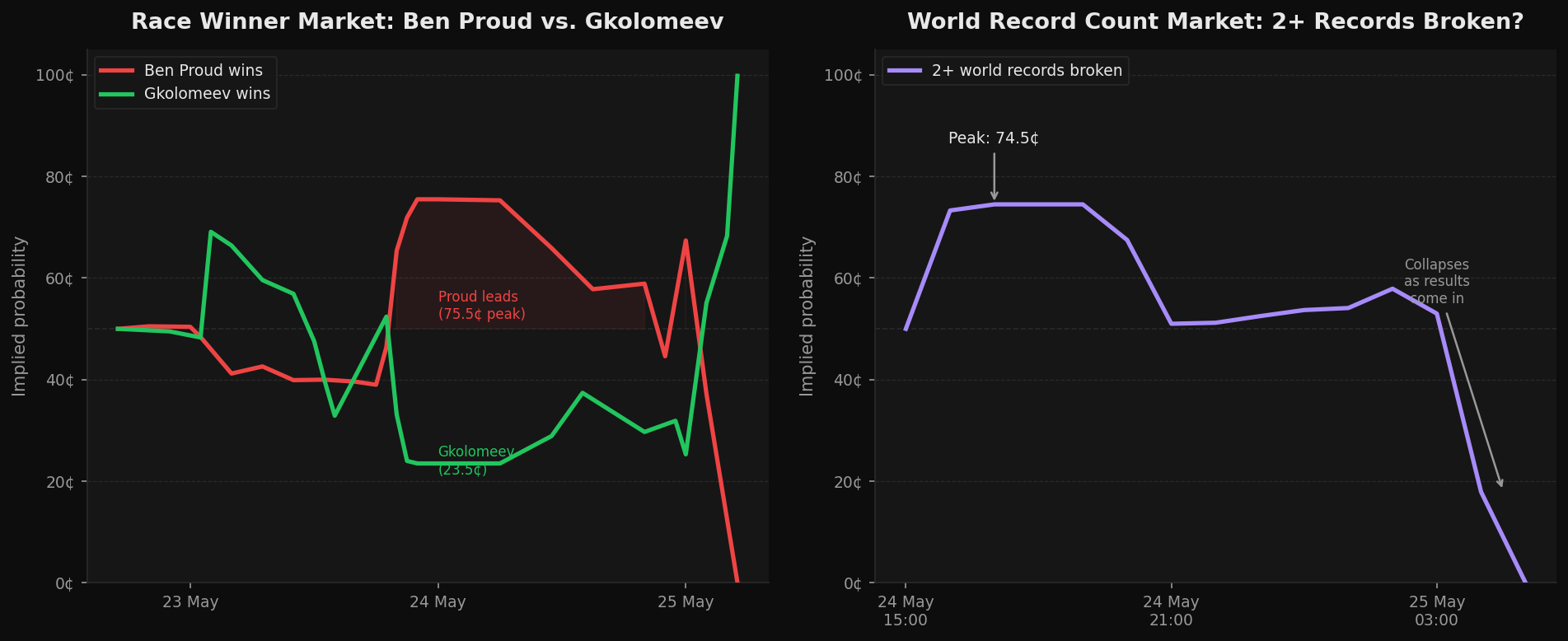
The crowd's macro thesis (many records fall) and their micro thesis (Proud wins) were perfectly aligned. Both were wrong. Only one record fell. Only one swimmer went sub-20.88. And it was Gkolomeev.
Quantifying the calibration gap
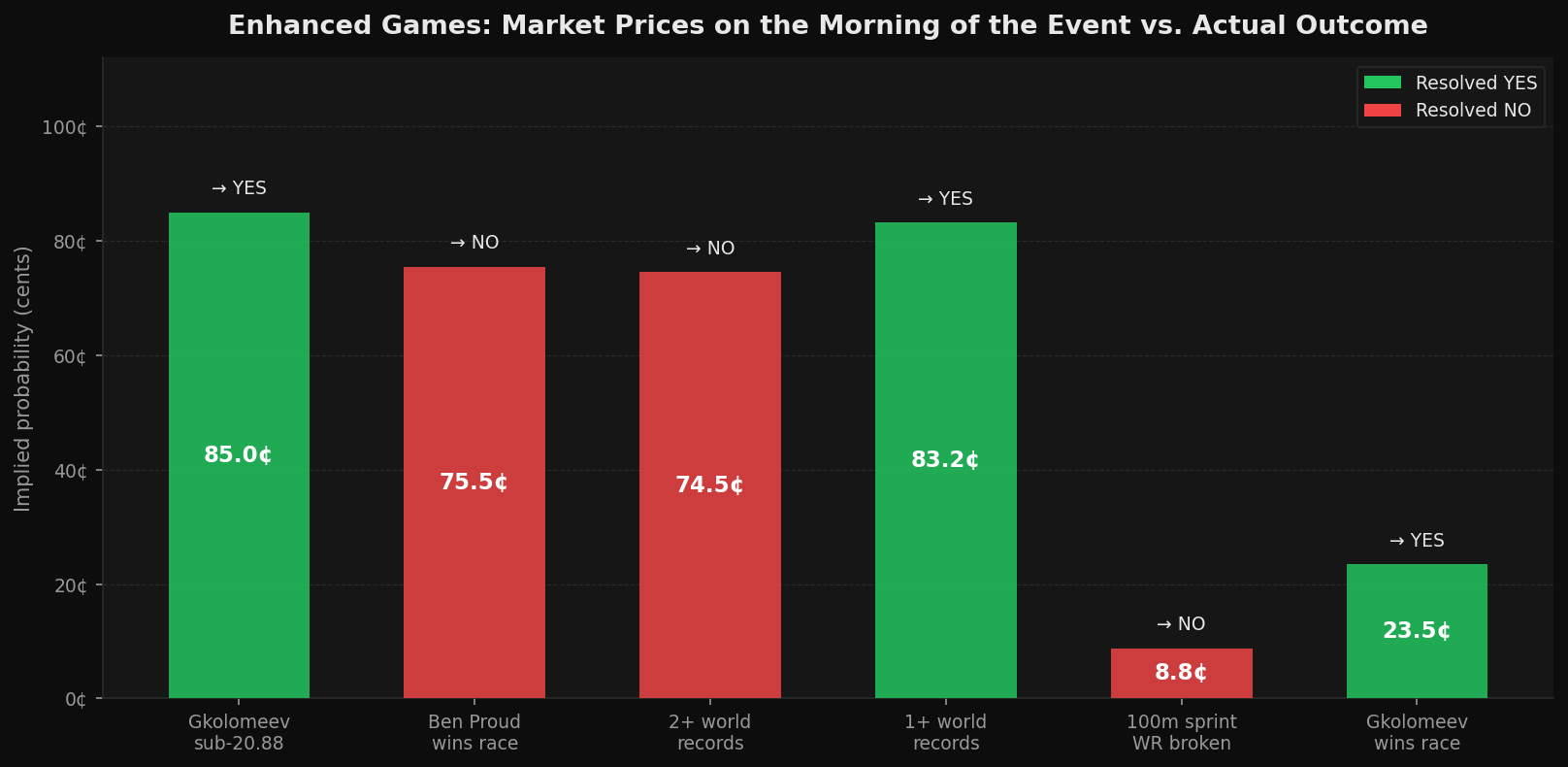
Here's the full scorecard across the key markets:
| Market | Event-morning price | Outcome |
|---|---|---|
| Gkolomeev swims sub-20.88 | 85¢ | ✅ YES |
| Ben Proud wins the race | 75.5¢ | ❌ NO |
| 2+ world records broken | 74.5¢ | ❌ NO |
| 1+ world records broken | 83.2¢ | ✅ YES |
| 100m sprint WR broken | 8.8¢ | ✅ NO |
| Gkolomeev wins the race | 23.5¢ | ✅ YES |
Four correct, two wrong. But the two wrong ones aren't random misfires. They're the same error stated twice: the crowd believed Proud would go sub-20.88 and win.
The Gkolomeev winner market is the most striking number. A 23.5¢ price means the crowd assigned him roughly a 3-to-1 underdog probability in a race where they simultaneously believed, at 85¢, that he would break the world record. That's the contradictory pair. It took about six hours of actual results to untangle it — the market didn't resolve cleanly; both the winner market and the 2+ WR market went through a noisy correction period between midnight and 5am UTC before final settlement.
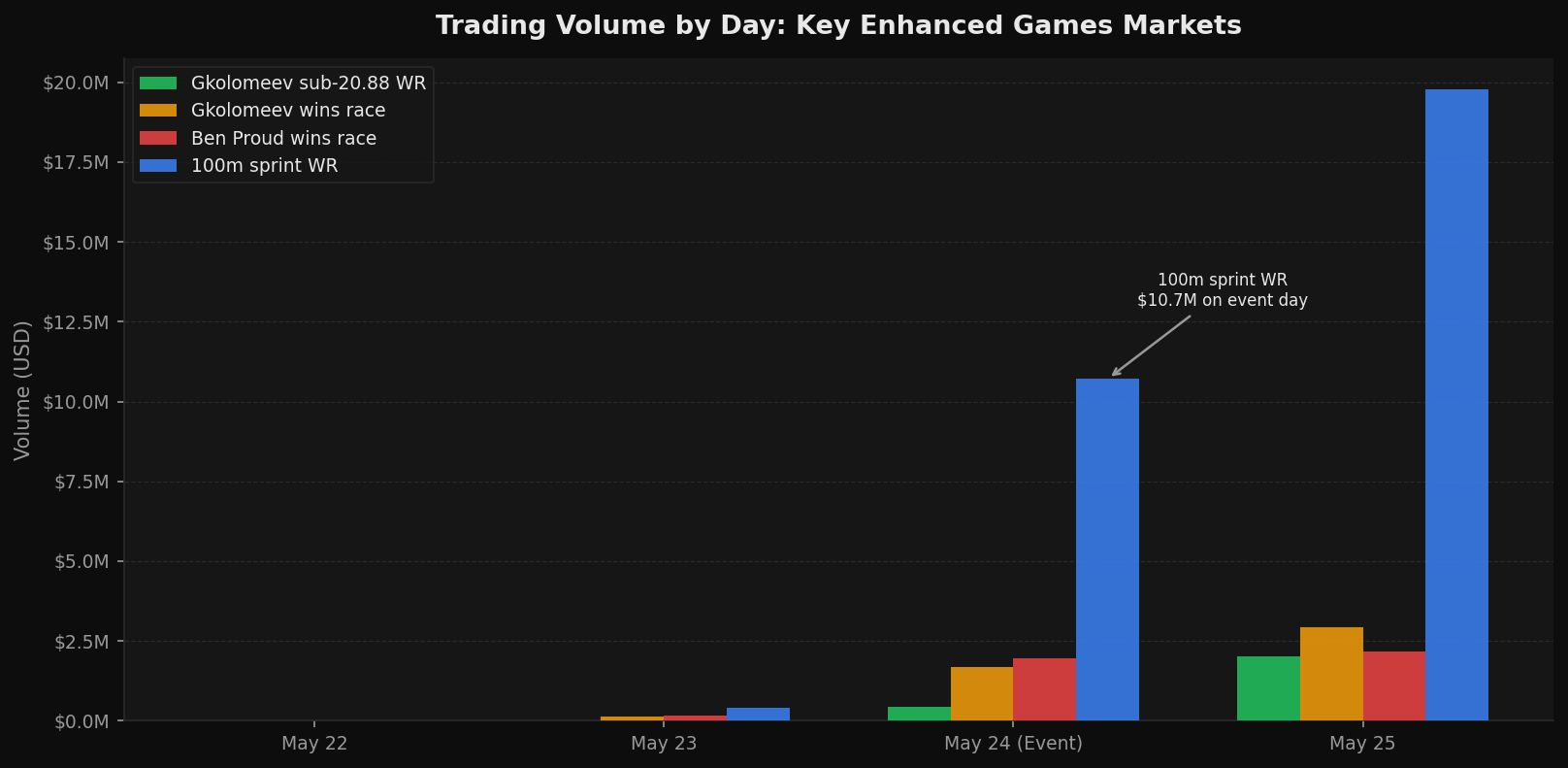
Volume tells a consistent story. The 100m sprint WR market dominated — $10.7M on event day, $19.8M on resolution day — suggesting that's where the most contested disagreement lived. The swimming winner markets were comparatively thin: $1.7M for Gkolomeev winner and $1.96M for Proud winner on event day. Thinner markets, more dislocated prices.
Pulling this data yourself
If you want to replicate this analysis, here's how to pull the price trajectories for both Gkolomeev markets using the polymarketdata.co API:
import requests
import pandas as pd
import matplotlib.pyplot as plt

API_KEY = "YOUR_API_KEY"
BASE = "https://api.polymarketdata.co/v1"
HEADERS = {"X-API-Key": API_KEY}

def get_prices(slug, start_ts, end_ts, resolution="1h"):
    params = {
        "start_ts": start_ts,
        "end_ts": end_ts,
        "resolution": resolution,
    }
    results = []
    while True:
        r = requests.get(f"{BASE}/markets/{slug}/prices",
                         headers=HEADERS, params=params, timeout=30)
        r.raise_for_status()
        data = r.json()
        results.extend(data["data"])
        cursor = data.get("metadata", {}).get("next_cursor")
        if not cursor:
            break
        params["cursor"] = cursor
    df = pd.DataFrame(results)
    df["t"] = pd.to_datetime(df["t"], utc=True)
    return df

# Gkolomeev world record market (sub-20.88)
wr_df = get_prices(
    slug="enhanced-games-kristian-gkolomeev-50m-freestyle-time-under-20pt88",
    start_ts="2026-05-23T00:00:00Z",
    end_ts="2026-05-25T12:00:00Z",
)

# Gkolomeev race winner market
win_df = get_prices(
    slug="will-kristian-gkolomeev-win-the-50m-freestyle-at-the-2026-enhanced-games",
    start_ts="2026-05-22T00:00:00Z",
    end_ts="2026-05-25T12:00:00Z",
)

# Filter for Yes token prices
wr_yes = wr_df[wr_df["token_label"] == "Yes"].set_index("t")["price"]
win_yes = win_df[win_df["token_label"] == "Yes"].set_index("t")["price"]

# The gap between what the market thought he'd do vs. whether he'd win
gap = wr_yes - win_yes
print(f"Max gap on event morning: {gap['2026-05-24'].max():.3f}")
# 0.615 — exactly the 61.5¢ spread we found
To reconstruct the cross-market arbitrage signal, pull the Ben Proud winner market (will-ben-proud-win-the-50m-freestyle-at-the-2026-enhanced-games) and compare his price to the 2+ world records market (will-2-world-records-be-broken-at-the-2026-enhanced-games). The two series move almost in lockstep until the event itself begins — they're pricing the same underlying belief from two angles.
The trading takeaway
The mispricing was detectable before the event. The logic is:
If Gkolomeev is 85¢ to break 20.88, and the "2+ world records" market is at 74.5¢, the implicit claim is that Proud also has a ~75% chance of going sub-20.88. But going sub-20.88 in the 50m freestyle is extraordinary — Cameron McEvoy held the clean-sport world record for years. The crowd was pricing two different swimmers breaking it simultaneously with 75% probability.
A paired position — long Gkolomeev winner Yes (23.5¢) plus long Proud winner No (24.5¢, the other side of the 75.5¢ price) — cost 48¢ total. Since these are separate binary markets on the same race, if Gkolomeev wins both tokens pay out: the Gkolomeev Yes and the Proud No each settle at 100¢, returning 200¢ on a 48¢ outlay. Maximum loss is 48¢ (both tokens expire worthless if Proud wins). At 50% confidence on Gkolomeev, the expected value of that spread was roughly +52¢ per pair — not a sure thing, but clearly positive.
The 2+ world records market was the tell. When it started drifting back below 50¢ at 21:00 UTC — while the winner markets hadn't yet updated — that was the arbitrage window: the crowd was quietly abandoning the multi-record thesis in one market while leaving the winner prices intact in another.
Markets on correlated outcomes within a single event don't always update in sync. When they don't, that gap is where the edge lives.
The Enhanced Games will be back. So will the prediction markets. And so will this kind of spread.
All data from the polymarketdata.co API. Full endpoint reference at polymarketdata.co/docs.