From 85% to 6.5%: What Polymarket's Iran War Markets Reveal After 22 Days
On day one of the US-Iran war, Polymarket gave 85% odds of a March 31 ceasefire. It's now at 6.5% — and 88% of traders expect the Strait of Hormuz to be nearly shut by the same date.

From 85% to 6.5%: What Polymarket's Iran War Markets Reveal After 22 Days
The "Iran x Israel/US conflict ends by March 31?" Yes token opened at 50¢ on February 28 — the same afternoon US and Israeli strikes began. Within six hours it hit 85.5¢. The crowd was pricing a quick, decisive engagement. Trump wins, Iran folds, deal by end of month.
That was 22 days ago. The token is now at 6.5¢, with nine days left on the clock.
That 79-point collapse is the most precise summary of how the conflict evolved: early optimism, a long grind, and no end in sight. Below we unpack what the full market structure says now — across four deadline contracts and the Strait of Hormuz probability distribution — and what traders are actually pricing for the weeks ahead.
The Arc of "Ends by March 31"
The price path on the March 31 contract is worth walking through because it maps almost perfectly onto the news cycle.
The market launched on February 28 at exactly 50¢. Within two hours — as confirmation came that US and Israeli strikes on Iranian nuclear and military facilities were underway and Iranian missile defenses were reportedly overwhelmed — the Yes token surged to 72¢. By 8pm UTC it hit 85.5¢, the all-day high.
The early logic: Trump had been warning Iran for weeks. Once strikes started, Iran would lose the ability to credibly retaliate and sue for peace quickly. Three weeks felt like enough runway.
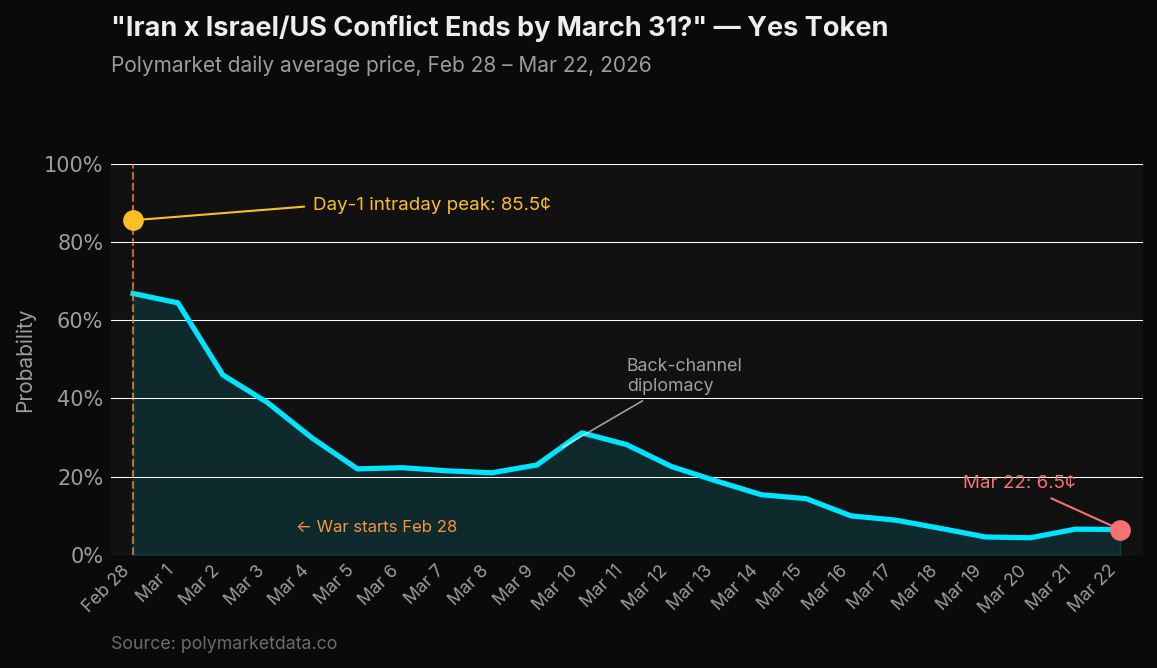 Polymarket "Iran x Israel/US conflict ends by March 31?" Yes token, daily average price. Annotated with key events.
Then the news shifted. Iran did not fold. The Strait of Hormuz went effectively dark. Oil topped $110/barrel. Iranian missile salvos continued — down 90% from week one in volume, but not stopped. The price gapped down to 46¢ by March 2, to 30¢ by March 4, and by March 16 it was in the single digits.
The March 9 blip to 23% and March 10 to 31% corresponds to a brief period of reported back-channel diplomacy. That window closed. By March 20 the token was at 4.4¢.
The Timeline Ladder
The more interesting read right now isn't the March 31 contract — that's effectively resolved. It's the full set of deadline contracts and what the spread says about the market's implied ceasefire timeline.
As of March 22:
| Contract | Yes Price | Implied Probability |
|---|---|---|
| Conflict ends by March 31 | 6.5¢ | ~6.5% |
| Conflict ends by April 15 | 24.5¢ | ~24.5% |
| Conflict ends by April 30 | 38¢ | ~38% |
| Conflict ends by December 31 | 81¢ | ~81% |
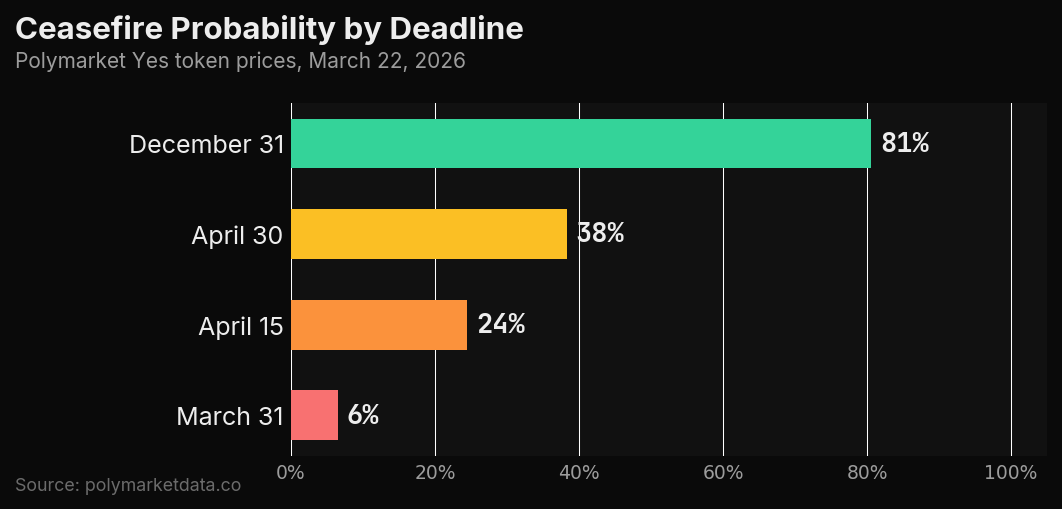 Probability of conflict resolution by each deadline, based on Polymarket Yes token prices as of March 22, 2026.
Reading the incremental probabilities:
- ~6.5% chance it ends by March 31
- An additional ~18% chance it ends April 1–15 (the window Trump's 48-hour ultimatum on the Strait is pointed at)
- An additional ~13.5% chance it ends April 16–30
- An additional ~43% chance it ends May–December
- ~19% chance it's still unresolved at year-end
The April 1–15 window is carrying disproportionate weight. That's where the optimists are sitting now. Trump's ultimatum — giving Iran 48 hours to reopen the Strait of Hormuz or face consequences — was issued this morning, March 22. The April 15 contract pricing suggests ~18% of informed money thinks that ultimatum, or the next one, actually works inside three weeks.
The Strait of Hormuz Distribution
The Strait of Hormuz markets are a separate cluster — launched March 9 — asking how many ships will transit the strait on March 31. They were created because the Strait is the real economic pressure point: roughly one-fifth of the world's oil and LNG flows through it, and Iran has been threatening (and partially implementing) a blockade since March 1.
The probability distribution as of March 22:
| Ships per day | Probability |
|---|---|
| 0–10 (near-total closure) | 54% |
| 10–20 (severe disruption) | 34% |
| 20–30 | 3% |
| 30–40 | 1% |
| 40–50 | 2.5% |
| 50–60 | 1% |
| 60+ (normal operations) | 5% |
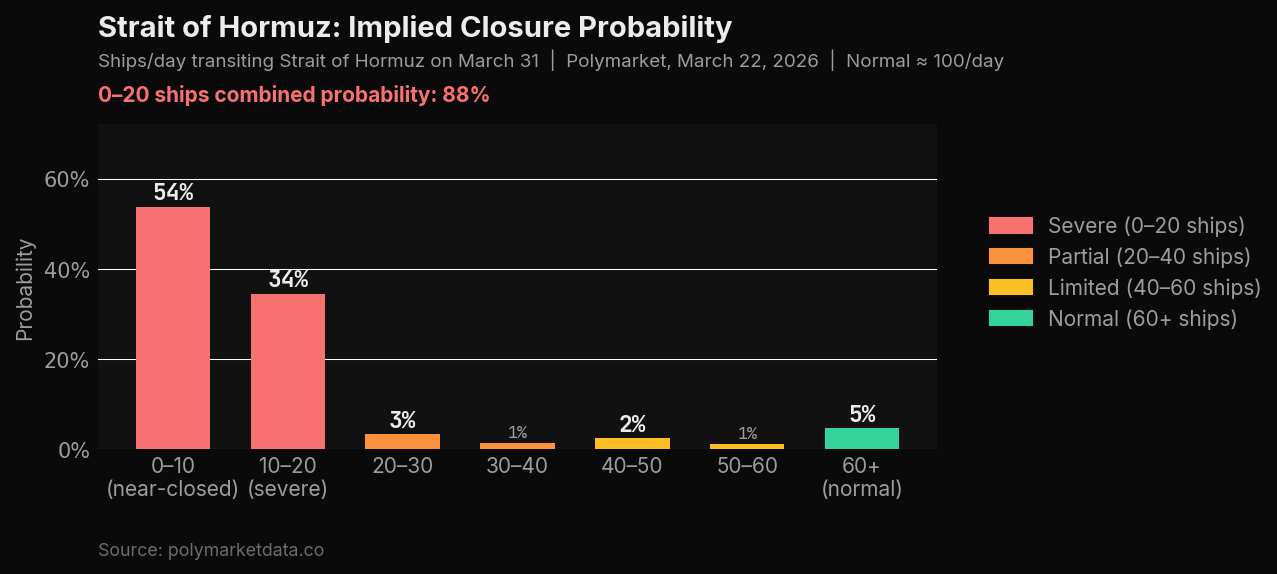 Polymarket bracket markets for average daily ship transits through the Strait of Hormuz on March 31, 2026. Normal operations = 60+ ships/day.
The combined probability of "near-total or severe closure" (0–20 ships/day) is 88%. The market gives only 5% odds of normal operations by March 31.
The 0–10 bucket has been the most-traded and has been climbing steadily since March 12, when it first appeared in our data at 56%. It hit a peak of 69% on March 16, pulled back to 53–54% in the last few days as diplomatic noise picked up. The 10–20 bucket has surged from ~14% to 34% over the same period, which likely reflects traders hedging between "closed" and "nearly closed."
Notice what's not priced: a re-opening. The 60+ bucket — which would require Iran to comply and ships to restart normal transit — sits at just 5%. Trump's 48-hour ultimatum may shift this by tomorrow, but as of market close today, the crowd is skeptical.
How to Replicate This
The ceasefire timeline data comes from the market_metrics_history and token_prices_history tables. Here's the core query pattern using the polymarketdata.co API:
import os
import requests
import pandas as pd

API_KEY = os.environ["POLYMARKETDATA_API_KEY"]
BASE = "https://api.polymarketdata.co/v1"
HEADERS = {"X-API-Key": API_KEY}

# Market slugs for the conflict-ends-by series
MARKETS = {
    "march_31": "iran-x-israelus-conflict-ends-by-march-31",
    "april_15": "iran-x-israelus-conflict-ends-by-april-15-618",
    "april_30": "iran-x-israelus-conflict-ends-by-april-30-766-662",
    "dec_31":   "iran-x-israelus-conflict-ends-by-december-31",
}

# Pull daily price series for each contract
frames = {}
for label, slug in MARKETS.items():
    r = requests.get(
        f"{BASE}/markets/{slug}/prices",
        headers=HEADERS,
        params={
            "start_ts": "2026-02-28T00:00:00Z",
            "end_ts":   "2026-03-22T23:59:59Z",
            "resolution": "1d",
            "outcome": "Yes",  # Yes token only
        },
        timeout=30,
    )
    r.raise_for_status()
    df = pd.DataFrame(r.json()["data"])
    df["t"] = pd.to_datetime(df["t"], utc=True)
    frames[label] = df.set_index("t")["price"]

timeline = pd.DataFrame(frames)
print(timeline.tail())
For the Strait of Hormuz bracket markets, the slugs follow the pattern will-there-be-between-{low}-and-{high}-average-daily-transits-of-the-strait-of-hormuz-on-march-31. Same API call, resolution="1d", outcome="Yes".
What to Watch
The March 31 contract will likely resolve No by end of next week regardless of the ultimatum — the conflict isn't ending in nine days. The interesting live bet is the April 15 contract at 24.5¢. That's where the "Trump ultimatum actually works" theory lives.
The Strait of Hormuz market resolves March 31 on observed transit data. If the 48-hour ultimatum produces even partial reopening, the 0–10 bucket at 54¢ is mispriced. If it doesn't — and Iran fires another salvo, as it did this morning at two southern Israeli cities — 54¢ may still be cheap.
The December 31 "conflict ends" contract at 81¢ has barely moved since it launched. The crowd isn't panicking about a multi-year war. They're pricing this as a medium-duration engagement — painful, disruptive, but not permanent. Whether that's right depends on who blinks first on the Strait.
All data from the polymarketdata.co API. Market slugs verified against live Polymarket contracts. Full endpoint reference at polymarketdata.co/docs.